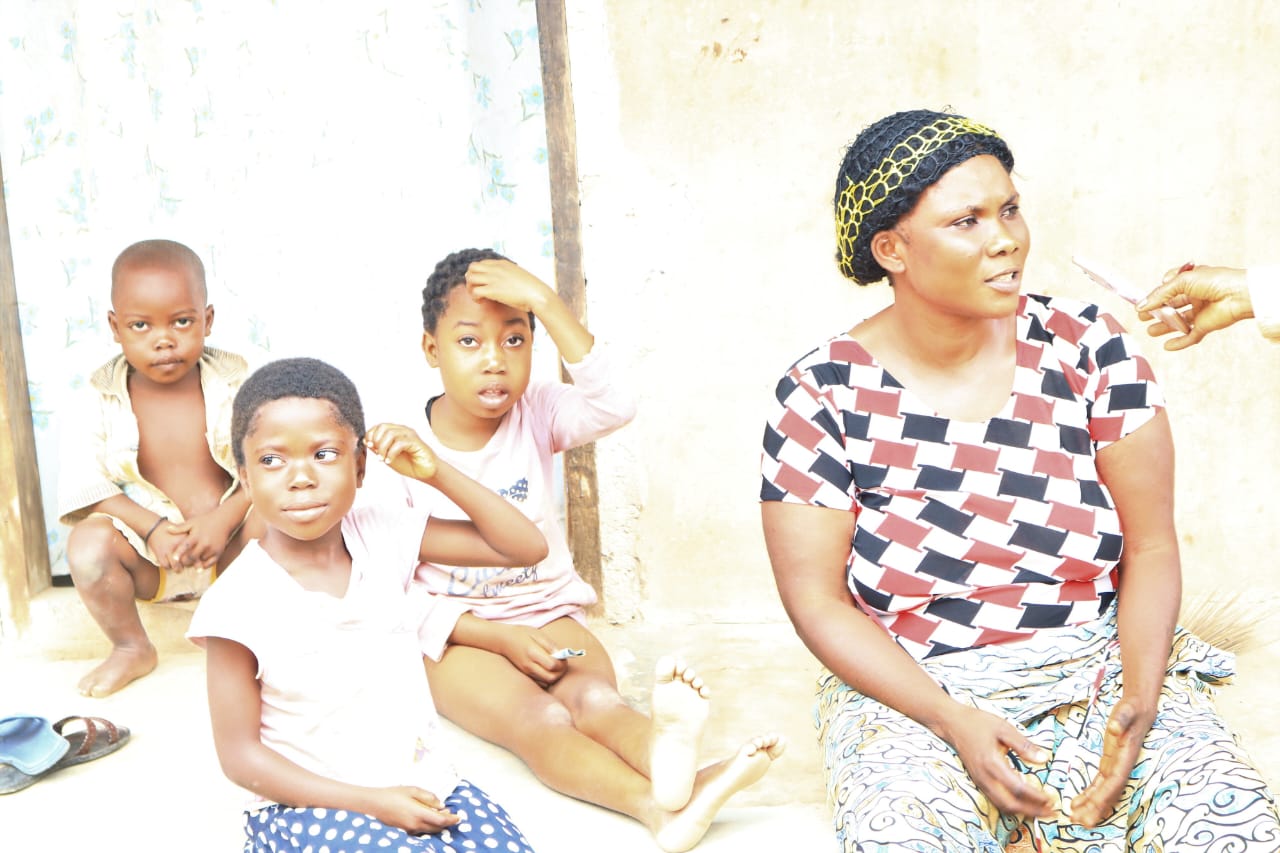
Patience Etowa and her children.
By Iwunze Jonathan
The dry season comes every year without apology. In Borum community, deep inside Boki Local Government Area of Cross River State, it arrives as a kind of quiet catastrophe — streams that sustained life through the rains shrink, then vanish. What remains is cracked earth and the memory of water.
Read Also: Clean Water on Paper: How Nigeria’s rural communities live outside the data
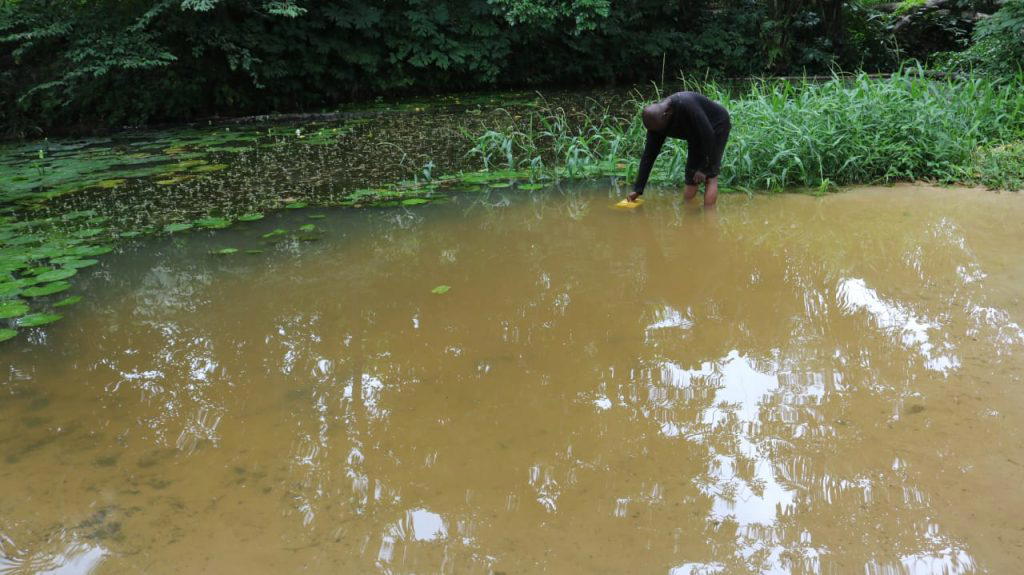
I walked into Borum on a bright Wednesday morning, past motorcycle traders hauling goods to a nearby market, past the manual-powered boreholes the community had pooled their own resources to build because the government’s interventions had left them with nothing functional. Then I walked further — into the forest, up and down steep hills, for nearly forty minutes — to find a small brook tucked inside the trees. That water body, called Abang Kache, was the last resort. A sacred source. The one that “rarely dries up.”
It was also contaminated.
That single fact — water that exists, that shows up on no government map as absent, yet delivers diarrhea and waterborne disease to the people who drink it — is the quiet crisis that Nigeria carries into every climate conversation, including the one the world will have at COP31 in Türkiye later this year.
What the Data Says. What the Data Hides.
Nigeria’s water access statistics, on paper, tell a story of gradual progress. The Joint Monitoring Programme for Water Supply, Sanitation and Hygiene reports that 38 percent of rural Nigerians have access to basic water service. Another 26 percent have limited access. Only 37 percent are recorded as having no service at all.
Those numbers do not capture Nurse Caroline Monjok.
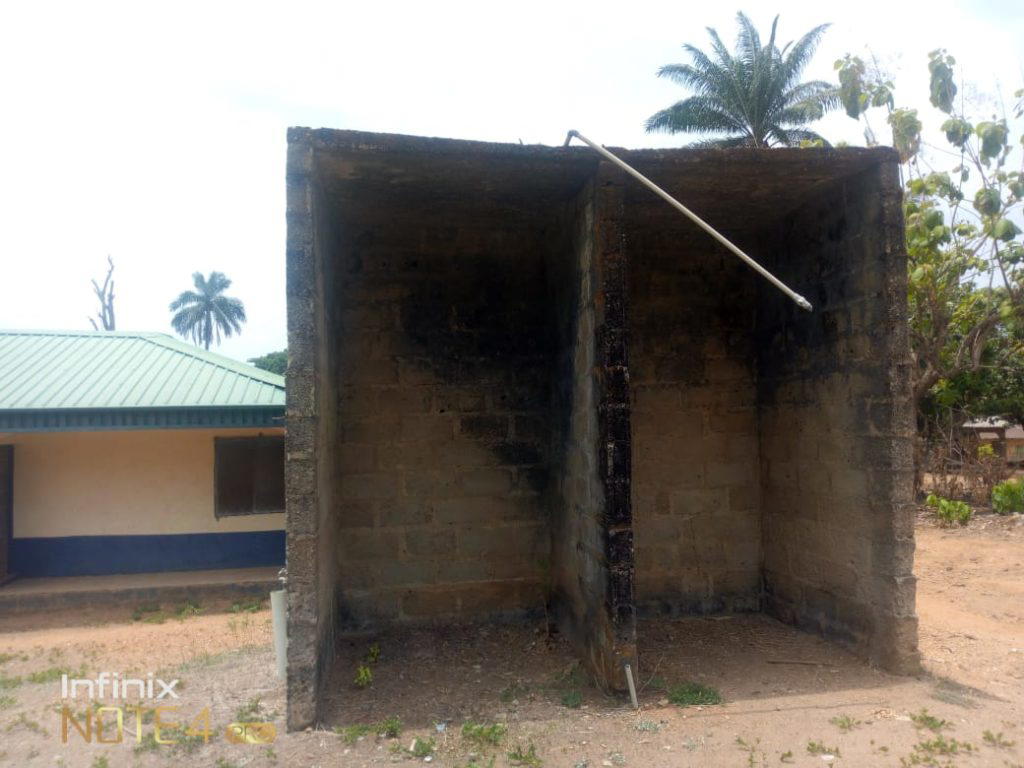
When I visited the Primary Health Care Centre in Borum, its government records would show it as a functioning facility. What I found was two broken geepee tanks collecting rainwater, a dry tube well, and an abandoned concrete tank stand — a relic of a water project that was never completed. Nurse Monjok, the officer in charge, had been waking before dawn to trek across hilly terrain to fetch water in a bucket. When the community’s boreholes failed her — locked by the very residents whose deliveries she was conducting — she turned to Abang Kache. The brook in the forest. The contaminated last resort.
The facility existed. The data counted it. The water did not come.
This is what development researchers call the infrastructure gap between installation and functionality — and in Nigeria’s rural communities, it is vast. A 2017 World Bank diagnostic found that around 25 to 30 percent of Nigeria’s rural water points fail within the very first year after installation. They are built, counted in the statistics, then left to break down. The numbers record the construction. They do not record the collapse.
Climate Is Making an Already Broken System Worse
What the statistics also do not capture is what happens when climate variability presses its full weight on infrastructure that was already failing.
In Biase Local Government Area, I met Patience Etowa in Afifia North village — a mother of three who woke at five every morning to make a forty-five-minute trek to a neighboring community just to access water safe enough to drink. The solar-powered borehole in the middle of her own community was too salty for consumption. The streams dried up in the dry season. The remaining water was used for washing cassava that became garri and fufu — the community’s daily food — meaning the contamination entered their bodies whether they acknowledged it or not.
In nearby Ikpariyong, I found a community that had achieved something remarkable: open defecation-free status, earned through years of volunteer-led enforcement by people like WASHCOM chairman Joseph Otu, who earned the nickname “shitman” for his vigilance. Yet both of Ikpariyong’s boreholes — solar and manual — were broken. Climate-stressed dry seasons lengthened. Streams that once supplemented supply during borehole failure were increasingly unreliable. Children developed diarrhea. The hard-won ODF status was under daily threat.
These are not anomalies. They are the structural condition of rural water access in Nigeria’s south, where communities build their own boreholes because of the government’s count completion rather than continuity, where nurses fetch water in buckets from forest brooks to conduct midwifery, where every dry season is a renegotiation with survival.
What COP31 Must Reckon With
The world’s climate finance architecture is built on data. Loss and damage funds, adaptation grants, WASH infrastructure investments — all of it flows toward numbers. Countries report, aggregators compile, dashboards publish. And somewhere in that translation, Borum disappears. Afifia disappears. Nurse Monjok disappears.
If Nigeria arrives at COP31 with statistics that count non-functional boreholes as serving communities, that record contaminated brooks as supplemental sources rather than failures of the system, then whatever climate adaptation funding follows will be misallocated. It will build where the data says there is a gap, not where the reality is.
The deeper reform is not more boreholes. It is an accountability infrastructure that counts what actually works — sensors on installations, community-level functionality audits, data systems that distinguish between a borehole that exists and a borehole that delivers clean water. CharityWater, the international organization, figured this out years ago: remote sensors on every installation, local community ownership built in from day one. Nigeria has the policy language — the 2000 Water Supply and Sanitation Services policy distributes responsibility across federal, state and local governments, NGOs, and communities. What it lacks is the will to measure outcomes rather than outputs.
Until that changes, the statistics will keep showing progress. The streams will keep drying. The nurses will keep walking into the forest.
And at COP31, the gap between what the data says and what the communities live will remain — unmapped, unfunded, and invisible to the climate finance that could change it.
Iwunze Jonathan is a WASH, Solutions and Data Journalist and founder of SPY Network Online Media. His reporting on water access, child rights, and rural governance spans over a decade of field work in Nigeria’s most underreported communities. He is a Bill & Melinda Gates Foundation fellow trained at Pan-Atlantic University’s Solutions and Data Journalism Academy.
Disclaimer
Comments expressed here do not reflect the opinions of Vanguard newspapers or any employee thereof.