By Morenike Taire, Woman Editor, & Ebunoluwa Sessou
Recently, the entire global entertainment world was glued to their screens as two Nigerian idols; crooner, David Adeleke a.k.a Davido\O.B.O; and screen siren of the Oloture fame, Sharon Ooja, both tied the knot with their significant others in the nation’s capitals of Lagos and Abuja.
The guests, the “steeze,” the venue, the cash, and of course the fashion, continue to generate unprecedented interest both at home and abroad a week afterwards. Videos have attracted more than a billion views across the globe, heightening interest in Nigerian culture and our way of life.
The fashion
On the forefront was the fashion, even with many Nigerians admitting to witnessing real Igbo and Idoma traditional weddings for the first time.
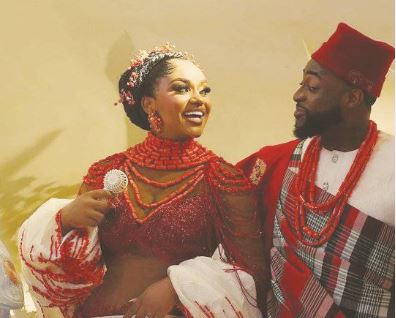
Chioma, the blushing bride of Davido had her global audience spellbound as the mother of three performed the wine-carrying ceremony with an authentic and captivating dance, donning the traditional hip cloth, cropped blouse and bold accessories mainly made of original corals.
For Sharon, her Idoma culture was thrust before the world with her black and red striped dress, which is known as the Apa or Edema, with elements of modernism, transparent corset and intricate beaded designs. This was combined with a traditional fan.
Nigerian culture on front burner
Speaking on the significance of placing Nigerian culture on such a high scale, arts and culture professionals told WO our identity crisis is resolving, due to the fact that people are beginning to understand the need to promote their natural identity against the western culture.
Artistic Director, Crown Troup of Africa, Segun Adefila said while different countries have been promoting their attires, Nigerians thought they should be like other people by copying their identity and imbibing their culture in terms of language, food and the clothes.
“Things are changing because all those attitudes are very unnatural. Now, people are going back to questioning their identity. Who am I and how do I reflect who I am through my culture, which is the totality of our ways of life including everything we do from religion to what we eat and how we dress, among others.
“People are beginning to see that we have so much to offer in terms of varieties and colours as well as designs; everything that comes together to make individual cultures unique. That is why I think, there is a revert to our own cultural way of dressing.
“The Ghanaians were the first in culture and identity with their kente. As at early 80s to 2000, kente was so popular and now, thankfully, we are also reacting with our adire, aso oke among others.
“We are beginning to ask ourselves of our unique selling points. If you find a Nigerian superstar in the midst of other stars, you might be questioning where he or she came from but if you find an Indian Star, you will know that she or he is an Indian in the way they dress and their makeup.
“Tattoos had to resurface in America before we started embracing it. Meanwhile, our mothers were the ones wearing tattoos in the olden days. What we are doing right now, is to be in the forefront of championing what our culture stands for. It will be nice to see everyone represent their countries with their attires and culture varieties. Because of our special diversity, I have not seen many countries that have something to offer than Nigerians.”
Adefila said it is important to know that the world itself is about marriage, saying it is a necessity to foster development and unity.
NYSC as cultural enabler
“Every culture in the world is hybrid. People are influenced by their interaction with other cultures and that is not going to stop anytime soon. The Black culture in America is thriving because the blacks were transported to the Americas. They brought their culture and language, ways of life and the food they eat.
“Nigerian government came up with the National Youth Service scheme to make students from one part of Nigeria go and understand the culture of another part of the country and this Youth Service has given birth to so many things. We have corps members getting married to one another. Human race is the only species that should be more united because of the way God created us,” he added.
Speaking on the significance of cultural representation, Founder, Correct Connect Foundation, Rev Fr. Anthony Aleakwe Odior, a Catholic Priest, said cultural identity, particularly African cultural identity, encompasses everything that defines a people, intellectual pursuits, spiritual beliefs, political and economic systems, trade practices, education, cuisine, attire, and overall lifestyle.
Cultural Identity and Attire
“One of the most visible representations of cultural identity is attire. African traditional clothing reflects who we are as a people and represents our different cultural communities. For instance, in Nigeria, the cultural attire worn by the Igbo, Hausa, Yoruba, and other ethnic groups immediately identifies their origins. When these attires are showcased globally, they represent and celebrate our cultural identity.
Cultural Export
“When Africans wear their traditional attire in other parts of the world, such as Europe and America, they are essentially exporting African culture. This prompts curiosity and admiration from others, providing an opportunity to educate them about African heritage. The vibrant colours and unique designs of our attire are visually appealing and spark interest, making our culture accessible and appreciated worldwide.
Local wedding attire, a paradigm shift
“The use of traditional African attire in weddings represents a paradigm shift among African elites. Historically, many have adhered to Western traditions, wearing suits and white gowns for weddings, a practice rooted in colonial influence.
However, there is a growing trend of opting for traditional fabrics like “ECR Gu” for wedding attire. This shift signifies a reclaiming of cultural identity and a move away from colonial legacies, embracing garments that reflect African heritage and status in society.
“Culture and religion are deeply intertwined. Religion or spirituality within a culture dictates how a community perceives and interacts with the divine. Every cultural group has unique ways of communicating with and understanding the divine reality. This spiritual perspective is integral to the broader cultural identity, shaping daily practices and world views”, he said.
Disclaimer
Comments expressed here do not reflect the opinions of Vanguard newspapers or any employee thereof.