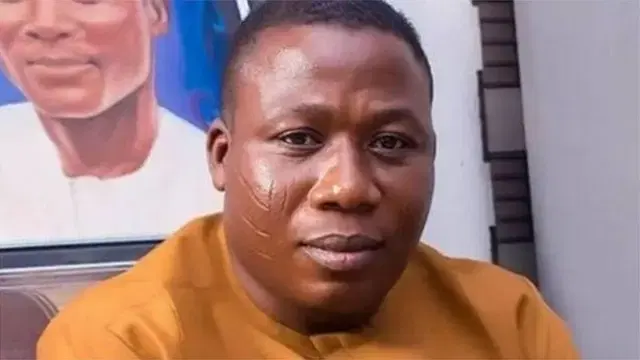
Sunday Igboho
By Toyin Akilo
‘’Every revolutionary ends up either a dictator or a corpse” – ALBERT CAMUS
The exploits of Sunday Adeniyi Adeyemo AKA ‘Igboho Oosa’ is the stuff legends are manufactured. In one fell swoop and with an authoritative ultimatum – 2 hours – yes, you heard me right, he did what Napoleon could not do by ordering the release of about 5(nos) kidnapped victims in his Igboho community from their captors. Like many of his fellow countrymen who has lost hope of liberation from the marauders who had terrorised the countryside for years without resistance, I was ecstatic that ‘’help is here at last”.
Can you blame us when the government that supposedly possessed the ‘’monopoly of violence” had abdicated their ‘’social contract” obligation to the superior firepower, intelligence and organisational ingenuity of criminal elements. The government is simply overwhelmed or complicit or what do you say to government officials cuddling, pampering and rehabilitating criminality.
Before I drill deeper into the antecedences of liberation figures in historiography and across ages. I want to plead on behalf of our dear countrymen and women in Esiele, Oyo State and Eda Oniyo, Ekiti State for the same grace the Igboho captives enjoyed from their illustrious son. If it will take the template of ‘Igboho Oosa’ to get them released after weeks in captivity, so be it.
The above narrative is not new – history is full of men and women who began as provincial protector of their kinsmen but ended as national fugitives.
William Wallace took up arms in 13th century Scotland to stop English soldiers from brutalizing Scottish villages. The people saw him as a saviour, the crown called him a traitor/outlaw and he was executed for treason in 1305. He won the battles of Stirling Bridge, crowd saw him as Liberator, Crown saw insurgency.
Pancho Villa started his own liberation war in chihnahia, Mexico in 1910. He took from the Rich landowners and gave to the poor, protected villages from Bandits and Federales before becoming a revolutionary General fighting against the Mexican Government itself. The Mexican state and US Government sent over 15,000 troops to hunt him until he was neutralized. Folk songs still celebrate his heroism till today.
Toussaint Louverture (Haiti, 1790s) began as a coachman, then led slave uprisings to protect free enslaved Africans. He was initially praised and venerated by French Revolutionaries before he caught the attention of the enigmatic and no nonsense Napoleon Bonaparte who branded him a rebel, arrested him and he died in prison under controversial circumstances similar to our own MKO Abiola.
Dedan Kimathi (Kenya, 1952-1957) fought to reclaim Kikuyu land taken by British settlers and protected villages from colonial police. He was declared terrorist, captured, tried and hanged in 1957. Colonial press called him ‘’savage bandit ‘’but he was a cult hero to his fellow countrymen.
I intentionally unearthed the above liberators to elucidate parallels in history of the Igboho phenomenon.
Noam choamky capture lucidly the potential conflict between a Liberator and Legitimate authority. ‘’The State calls its own violence ‘’Law” and the violence of others ‘’Crime”. Robert Green in his 48 Laws of power and Nicollo Machiavelli in his timeless treatise both emphasised the folly of sharing limelight, and authority with the principal (Prince).
In 2021, Sunday Igboho became a household name in Nigeria not for breaking the law but for enforcing a version of it. When Fulani herdsmen clashes threatened Yoruba farmers, he picked up the mantle of community defender. To millions, he was a liberator, a man who stepped in where government had abdicated responsibility. To the State under President Buhari, that same action crossed a line. Within months, the defender was declared an outlaw, his house raided and his freedom curtailed. He is therefore on familiar territory with his recent activism.
There are parallels in history and patterns that hardly shift: They all start with protection, clash with power, get re-labelled, hunted, arrested and most often executed. The line between hero and outlaw is rarely drawn by morality, more often, it is drawn by who holds the monopoly of force.
This piece traces that line – from Igboho in modern Nigeria back through Wallace in 13th century Scotland, Panchio in Mexico, Lampiao in Brazil, Toussaint in Haiti, Dedan in Kenya and others to comprehend why societies keep producing Robin Hood and why States keep outlawing them.
History has a cruel habit of turning defenders into corpses or statues. Wallace got the gallows in 1305, Dedan got the noose in 1957, Lampiao ended tragically in 1938, while Toussaint died in prison. All of them started by protecting their people and all ended losing their lives to the state.
Sunday Igbohos story is still loading, he has already outflanked exile, raids and extradition. Survival is however not the goal, legacy is. Nigeria cannot afford another Robin Hood who ended in blood and martyrdom. Igboho must not end the way of other liberators. He must live long enough to see the justice he fought for institutionalized, not just legend.
Justice delayed denied Wallace, Toussaint, Dedan, and Lampiao. It must not deny Sunday Adeniyi Adeyemo Igboho, Omo Baba Igboho, Igboho Oosa.
Disclaimer
Comments expressed here do not reflect the opinions of Vanguard newspapers or any employee thereof.