By Osa Mbonu-Amadi
Nigerian visual artist and curator, Adeola Ayoyinka Erinfolami investigates embodied emotions in a new series aptly titled, “Smile Studies.”
As the broad title suggests, Smile Studies anchors on the various shapes of the mouth accompanying a smile. This collection demonstrates Adeola’s interest in turning fashion and textile materials into documentations. Each piece conceptualises “Smile” as an intentionally constructed surface instead of a universal feeling.
The viewer is tasked to interrogate the gesture and decode the embedded messages, meaning, and perhaps determine the boundaries between externalised facial expressions and embodied social realities.
Adeola deliberately structures the series in segments and grades the textile materials into a formal sequence, ranging from “Smile Studies I” to “Smile Studies IV.” Describing the material explored in each phase, the artist provides cues for the interpretative journey: “Stitched Burlap”, “Wool and Wire”, “Denim and Buttons”, “Jacquard”, “Pearls”, and Rusted Wire” among others as the dominant materials.
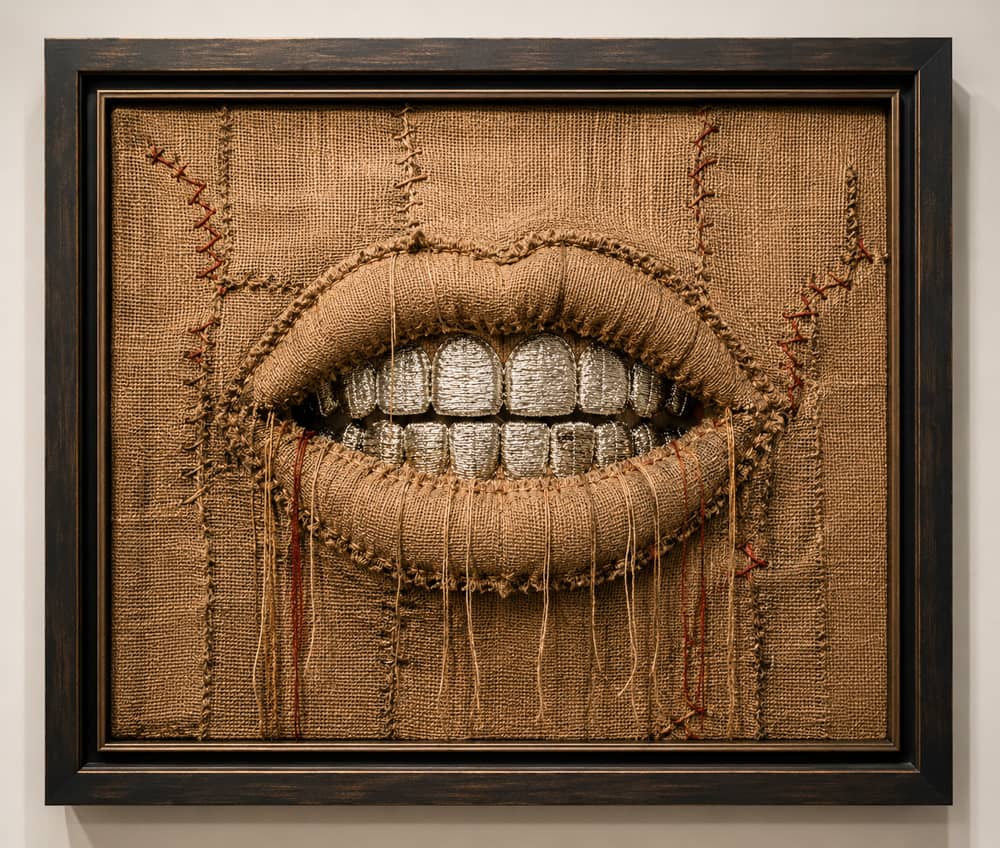
Smile Studies I: Stitched Burlap opens the series with subtitled description of the rough sack as raw and coarse. Metaphorically relating this to honesty and endurance in labour and trading, Adeola uses the simple background to create a mouth with exposed seams that enact the process of producing something.
The accompanying embroidered teeth reflect perfection. Running a silver thread through a rough sack bag, the artist conceptualises beauty and composure as contrasting embodied experiences pitched on worn objects curated as skin with visible stitches, loose threads, and patch-like repairs, functioning as emotional scars. Instead of showing genuine emotions of joy and conviviality, the smile appears cosmetic and forced.
“Smile Studies II: Wool and Wire” conveys a sense of subtle control. The textile processes in this piece include the intertwining of softness and architecture with “wool” to represent warmth and using wire as a binding thread. This culminates in a “mouth” that plays dual roles: a comforting and retraining instrument. The smile is portrayed as an suspended process. This instantiation of imperfection is heightened by the maneuvering of the wire and loosening of fibre in repeated wrapping, stitching, and tacking of textile materials.
In “Smile Studies III: Denim and Buttons”, Adeola uses worn jean fabric and buttons to navigate complex conversations about individual identity, memory, and labour. The denim triggers metaphorical associations with work clothes and repeatedly used commodities.
While the denim is curated as skin and archived memory, the small buttons are manipulated to represent human teeth. However, the simplicity of the buttons adds a fascinating twist to the commentary mirrored in the “stitched portrait of survival.” The artist employs fragmented and worn objects to create smiles, weaving emotional labour into daily activities.
“Smile Studies III: Denim and Wool” is a conceptualisation of beauty in a choatic and decaying setting. An ornamented figure is collaged on the surface of woven fabric, revealing that it sprouts from a fading memory of what used to be.
The stitching of “pearls” in a rusted framework suggests a sharp contrast in this particular frame. Adeola’s collage integrates objects of beauty, value and class with worn out, decaying, and corroded ones. In one instance, she showcases an attractive smile set against the backdrop of decomposing skeleton. This framing includes a wire suspended above patterned fabric to create a silhouetted background that makes the fragile smile prominent.
While speaking on the relevance of her subject matter as a social construct, the artist notes that a smile performs a number of functions: “It comforts, protects, reassures, conceals, and persuades.” These functions are unearthed in the four parts. In Stitched Burlap, the artist evokes a tone of honesty and endurance by exploring a coarse and raw surface to exhume the embedded tangible experiences of abstract concepts like storage, trading, and manual labour, into an artistic narrative.
Adeola’s fascinating choices across the mixed-media and sculpture reflect in her material selection, creation of surface textures, organisation of textile and sculptural processes, including stitching, wrapping, and padding.
The body of work captures emotional undercurrents through symbolic objects. She uses stitches for scars, wire as scaffolding, denim as archived memory, and pearls for beauty.
While applying available local materials to enrich her work, the artist demonstrates environmental sensitivity by reusing already used objects to create beauty even in a chaotic environment.
Adeola’s experimentation with common materials like wool, fabric, and wire, culminates in value-laden objects that have the potential to enchant art lovers. The artist masterfully navigates through human body language to extract smiles, and then deploys worn fabric, buttons, wool, and wire to document the resulting emotional performances for the viewing public.
Images presented in the series are portable, easily relatable, and catchy enough to spur viewers’ imagination.
Adeola’s Smile Studies series conceptually focuses on isolated smiles, stimulating introspection. Even without adequate contextual clues like gestures, dressing, and other signifiers relating to facial fields, viewers can interpret the embedded messages by examining the shape of the lips. For instance, a restrained smile signals concealment of inner pains despite a dominant convivial atmosphere.
By juxtaposing coarse and soft materials in each piece, Adeola delves into didactic compositions, reflecting divergent perspectives of moral and value systems. Lurking within a broad smile might be a sinister motive, subtle control, or an art devoid of warmth as each smile in the series is shrouded in mystery. Rather being confined to a simple interpretation, they defy straightforward simplification. Even beauty related themes that hinge on perfection are realised from imperfect frames.
Smile Studies is framed as an open-ended narrative which can be innovatively transformed into formats, allowing the viewer to dialogue with the clothing patterns or mentally extend them to imagine installations of heights, sounds, lighting, and social interaction.
Although the artist isolates the mouth, showcasing the lips and teeth, the viewer can interrogate the depicted social performance by relating with the objects via their storytelling roles.
With well-sculptured textile materials, Adeola explores smile, not just as a random facial expression, but as an orchestrated art, a costume worn to impress, and clothing designed to cover internal conflicts.
In Smile Studies, Adeola exemplifies finesse in conceptual framing, material integration, and aesthetic display. The artist ingeniously combines textile and sculptural processes to interrogate memory, intent, emotion, and social realities. Her mastery of the subject matter — smile as a tactile experience — is evident in her choice of material for each expression and tactful infusion of her curatorial knowledge in translating abstracted physical forms into a relatable emotive experience.
The Smile Studies series positions the creative as proficient in contemporary art. It demonstrates how fashion and real objects can be explored beyond decorative frames to propagate culture, stage emotions, and interrogate social relationships through artistic narratives.
Disclaimer
Comments expressed here do not reflect the opinions of Vanguard newspapers or any employee thereof.