By Osa Mbonu-Amadi
In her work, Cost of Appearance, Boluwatife Esther Folorunso explores the Nigerian currency as a fashion statement.
With the emblematic title “Cost of Appearance”, the artist primes visitors to expect visual narratives that ride on economic and socio-cultural terms.
Cost of Appearance builds on Boluwatife’s previous work with subtitles like “Spent Monuments”, “Tender Currency”, “Paid in Full” which depict money as symbolic pointer to the power, culture, character traits, and level of influence an individual, or a state, has in relation to others.
The artist uses the register of money to picture group behaviour, dressing, and interactions in diverse socio-cultural contexts.
Boluwatife masterfully crafts the Cost of Appearance series to portray currency beyond its physical appearance, to include its visible impact on the society and individuals represented in the figures she stages.
The visual artist, whose work cuts across photography and painting, investigates how a people’s attitude, and value system in relation to money define their collective identity
Boluwatife essentially majors in mixed media and photographic works exploring different denominations of the Nigerian currency which she creatively subjects into storytelling roles about the history, cultures, and values of the people.
From the banknotes, Boluwatife mirrors the lifestyle of Nigerians, highlighting the dressing, ceremonies, and other engagements in which money is displayed.
By creatively transforming money into fashion statements, the artist metaphorically depicts wealth as a wearable entity. She further explores the currency as a social indicator of status, influence, aspiration, and aesthetics.
Money in Boluwatife’s work performs multifaceted roles: means of exchange, emotional booster, fabric, and cultural symbol.
Figures with partly covered face and varied shapes of the mouth-wide, grimacing, and clenched or bared teeth reflect caricatured persons rehearsing a performance meant for a third party. The creative masterfully weaves diverse denominations of old and new Nigerian banknotes to depict prevalent socio-economic realities.
Through figures adorned in Nigerian banknotes, Cost of Appearance conveys African experience, recounting tales of colonialism, gender roles, social positioning, and economic instability, as in juxtaposition of old and new notes, to document Naira redesign and its frequent devaluation.
With Cost of Appearance, Boluwatife critiques how human expectations condition their economic and social behavior, focusing on the painstaking measures women take to appear in the public space.
Typical of Boluwatife’s artistic style, the body of work is etched in archival materials that recount histories, expose socio-economic inequalities, societal value system, stereotypes, and complexes.
By recontextualising money as a cloak or even mask, the artist stages a visual discourse on the role money plays in a typical African society, specifically Nigeria.
Boluwatife’s ingenuity in blending photography, painting, and mixed media, makes Cost of Appearance a masterpiece with a distinct visual identity: a touch of portrait, sculpture, still life, and storytelling.
Some pieces in the series reveal that appearance could be a disguise, cultural display, or routine performance.
Boluwatife creatively hides the identity of her figures, thereby portraying them as universal images metaphorically representing people in a contemporary society where many pretentiously live to impress or deceive others. Individuality is blurred, but could be imagined subtle pointers like scars, culture-specific and symbolic objects that resonate with target viewers.
Some of the artworks reveal a disconnect between physical appearances and the emotional, psychological or even mental disposition of each persona. What late Nigerian Afrobeat creator, Fela Anikulapo Kuti, described as “Suffering and Smiling” signals merry-making on faces that are buffeted with inner struggles.
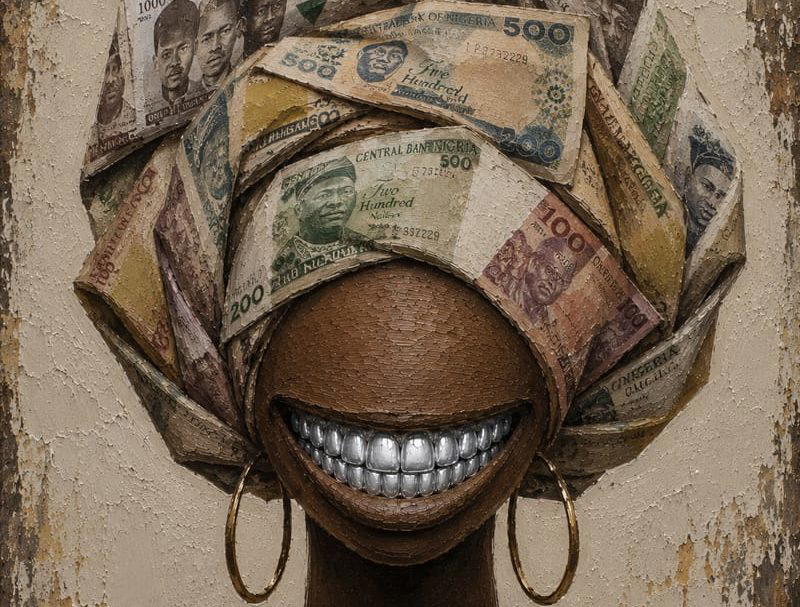
In another of the paintings, the artist depicts a tall, faceless figure in costumes made of different denominations of Naira, whose broad smiles and expansive headgear appear overly cosmetic, leaving the viewer to interrogate its implications.
With thick paint positioning folded banknotes, Boluwatife shows how money influences individual and group behaviours as well as social relationships. From the curved shape of her mouth, a figure wearing an expensive-looking necklace is staged to instantiate contrast between an impressive outlook and unspoken “heart matters”.
At the surface, the image impresses the observer as not only well dressed, but merry and satiated, but a closer look reveals that all is not well with the persona. For instance, the “missing eyes” could be a metaphor for a disability such as blindness, character defect, insolvency or anything that no one else sees. But, the figure is portrayed in such a way that the public readily sees the good while the dark side remains personal.
In Cost of Appearance, Boluwatife converts daily social activities into visual culture, revolving around the subject matter with subtle references to diverse themes bound by a common thematic thread.
Among other things, the body of work interrogates the motive behind appearances. In some, the real feelings are masked to hide inner turmoils, disappointment, inadequacies, or intents. Themes of materialism is expressed through the opulent composure of figures in festive attires. Through wearables like jewelry, cap, crowns, headwraps, and locally crafted headgears (gele), the artist showcases portraits reminiscent of social gatherings (owa mbe), exploring gestures and facial expressions like smiles to uncover either genuine or pretentious moods.
Each image is staged to instantiate the pivotal role money plays in people’s daily lives, mirroring its palpable influence. However, the viewer is left to decipher the embedded details and discern the person’s implied intentions.
Boluwatife captures the essence of the innovative experiment in her own words, saying, “In Cost of Appearance, I explore the relationship between beauty, value, identity, and performance through exaggerated feminine figures adorned with currency.”
Three of the artworks curiously drive Boluwatife’s message home: a female figure that wears a designer hat draped in ₦1000 notes. Two others are in expansive headwraps woven from bundles of ₦200, ₦500, and ₦1000 notes. The conspicuous absence of the least bills- ₦100 and ₦50 silently voices the idea: “It takes good money to look good.” Despite elaborate makeup, banknotes, earrings, and cosmetics, their eyes, nose, and ears are covered – a blindfold, suggesting that their dressing performance is to please their target audience and not for their own pleasure.
Disclaimer
Comments expressed here do not reflect the opinions of Vanguard newspapers or any employee thereof.