
By Prince Osuagwu, Hi-Tech Editor
Recently, global industrial software and Industrial Intelligence giants AVEVA made a strategic business decision to separate its legacy market, Middle East and Africa, into two markets, keeping each as a stand alone market.
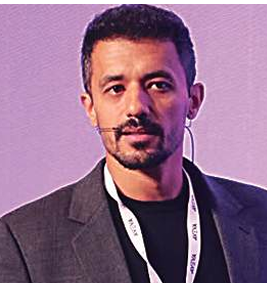
Following that decision, it appointed Khaled Salah, one of its bright young executives as the Vice President of Africa operations.
On take off, one of the first key actions he undertook was to organize AVEVA DAY NIGERIA, an annual executive technology conference aimed at empowering local industrial sectors to adopt digital transformation, Industrial AI, to enhance efficiency.
Climbing down the podium of the event, Hi-Tech corners Salah for a chat and the conversation is both interesting and very revealing
You hosted Aveva Day in Nigeria. That may have cost some fortune. Why do you have that level of interest in Nigeria?
Nigeria is really the heart of the digital transformation in Africa, for a couple of reasons. The first reason is, if you look at the population, almost like 30 percent of the population are under 30, like 60 percent I think, under 30, so most of the population are really young, and they have the right ingredients and the right skills to take the country to a different level.
The second point is the experience in oil and gas. There are major oil and gas companies here that we can support to the next level of transformation. The other point is that there is a lot of initiative here, including the NIN project which is quite impressive. Now, with almost 127 million on this programme, it will create data regularity. We could see that the government is investing a lot in the transformation of the country. So, all these ingredients motivated us to get closer to Nigeria.
So, what are you bringing with Aveva day?
I would like to say we are bringing a new way that Africa should manage its transformation. And, the message is Africa for Africa. This is what I mentioned on the stage today.
And what does that mean?
It means that we need to prioritise what the continent needs. No one should just bring a global standard and push it to Africa. This will not work. For us, we tailor our technology, our go-to market and our model to Africa. This is our strategy; to utilise the local content, the students, the talents, the partners, support them to innovate on our technology to support the customers. This is because we see Nigeria as a potential.
You’ve talked about investment, and about local talent development. Can we have specifics on these investments?
The first investment we’re going to make is on our technology partners here who resell our technology to the customers. We will give them the best training and the best technology.
We will also engage with some universities here in Nigeria, and open some free education and learning on our technologies to them
We will bring talents from engineering school who are about to graduate, and give them education.
On the other hand, we will engage strongly with the universities in Nigeria. We will give their students our solution to be built in their laboratories, so, at their final stage before graduation, they can have hands-on experience which will bridge the academic theories with practical experiences. This is because in reality what you study in university is not what you see in the outside world.
There is this FX pressure on businesses in Africa, what kind of solution do you think will help ease businesses and grow them exponentially?
Our solution in that area does one simple thing: Support customers to utilize the power of their debt. Every customer has a debt, but they don’t utilize the power of the debt. I spoke to a customer two days ago in Abuja, the question was: How can I increase production and or decrease the utility bill? To do that you need to bring the data of the organization, put data into context, so you can have enterprise visibility to see what’s happening.
You must have studied the market and discovered pain points before coming here. Can you share the gaps you discovered?
We work with customers in three stages. The first stage is what we call gap analysis. So we do the first assessment to understand where they are from at a digital maturity standpoint, and what are the gaps. And then we can advise the customer with some solution to cover the gap. The second point is the implementation. We implement the software, we make it up and running. The third point is adoption. We don’t just give the customer the software and go back. We support the customer to adopt the software.
There are international best practices, but then there’s also local-based governance systems that you may find in different markets. How do you balance standards in the markets you operate?
I reinforce the point of local for local. I think one of the successful models around us is China and India. Why China and India have been successful is because they do China for China and India for India. So for us, like I said,we need to do Africa for Africa.
We will go with the local model, with the local governance, relying on the Nigerian partners to tell us what is the best way to navigate the sector.
What is unique about Aveva platform and technology?
It’s interoperable, and it’s an invitation for all partners and technology providers to innovate on the top of the platform. If you have attended the presentation today, and you saw Connect, we have partnered with a lot of customers, because we’re an easy platform with a strong data foundation.
Yeah, I’d like to take you up on some partnerships you recently signed with the global tech giants, and for Nigerian companies that’ll be using your solutions. How will they benefit from these global partners?
Those global partners exist in Nigeria as well. So, if we speak about Databricks, if we speak about Snowflake, they exist in Nigeria, they are here, AWS, they exist here. So, it means our partnership with those giants make it easier for the customer to work with us.
You spoke about your Connect platform, which aims to bridge operational and information technology. Why is this integration becoming necessary to business owners?
Connect is our virtual experience. We provide this virtual experience to the customer. We enable them to have better access to everything they need to design, build, operate, optimize.
Okay, so looking at the challenges in Nigeria, infrastructure skills gap, and all that. What would you say is the biggest single challenge that is limiting manufacturers and other companies from enjoying the benefits of AI and digital trends?
I think the challenge for Nigeria is scalability. The technology exists. We have the technology right now. We don’t need to wait 10 years for it. We have all the technology, it exists really, but the point is we are now in a pilot phase. You go to every company, they are doing a pilot here, pilot in this production line, pilot in this machine. We haven’t moved from pilot to scalability, and I think that is the next stage of evolution Nigeria will go through.
Disclaimer
Comments expressed here do not reflect the opinions of Vanguard newspapers or any employee thereof.