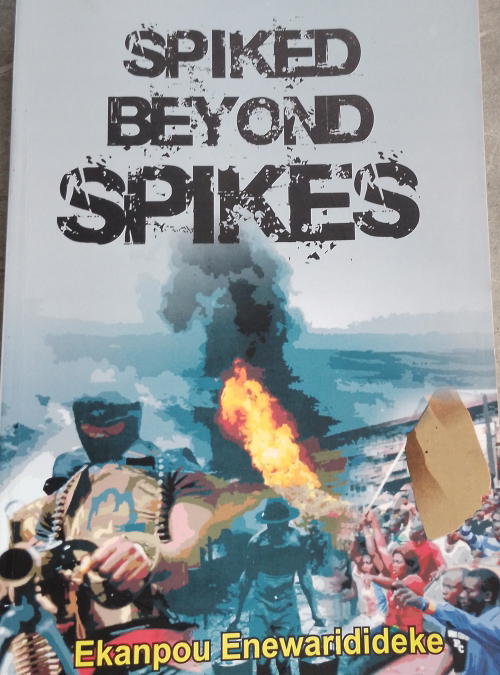
Book: Spiked Beyond Spikes
Author: Ekanpou Enewaridideke
Reviewer: Ebikabowei Kedikumo
Ekampou Enewaridideke’s Spiked Beyond Spikes is a political novel set in the Niger Delta region of Nigeria. The novel presents a society divided by power, oil wealth, ethnic domination, poverty, and state violence. Through the figures of Alabeni and the Ozidi Boys, the novelist explores resistance and militancy as responses to oppression. The government of President Waibode represents a ruling class that controls state power and uses it to protect its own political and economic interests. On the other hand, the Tobu people of southern Oporoza represent the exploited oil-producing communities whose land produces wealth but whose people remain poor, abandoned and oppressed. A Marxist reading of the novel therefore helps us to understand the conflict as a struggle between the oppressors and the oppressed, the ruling class and the exploited class.
Marxism is useful in this study because it sees society as being shaped by economic relations and class struggle. Karl Marx and Friedrich Engels (2002) argue that “the history of all hitherto existing society is the history of class struggles” ( p. 219). This idea is central to Spiked Beyond Spikes. The novel shows that the conflict in Oporoza is not merely a personal quarrel between President Waibode and Alabeni. Rather, it is a wider struggle over who controls the oil wealth of the Niger Delta. The Ekisas of the North dominate the political structure, while the Tobus of the South produce the oil wealth but suffer poverty, pollution and neglect. In this sense, the novel dramatises the Marxist belief that political power is often used to defend economic advantage.
From the beginning of the novel, the reader is introduced to a society where criticism of power is treated as a crime. Sergeant Ololo attacks Endorobou because of a lecture in which he uses the image of King Temugedegede. Ololo believes that the image is an insult to Mr President. However, Endorobou insists that his lecture is meant to guide the President away from “sycophantic derailment”. This opening conflict shows the repressive nature of the state. Under President Waibode, language itself becomes dangerous. Intellectual criticism is interpreted as rebellion. From a Marxist point of view, this shows how the ruling class controls not only the economy but also ideas and speech. The government wants to decide what can be said, who can speak, and how the people should interpret political truth.
Furthermore, the politics of representation is clearly seen in the way Alabeni is presented by different groups in the novel. To the government and its agents, Alabeni is a criminal, an outlaw, and a sponsor of violence. Sergeant Ololo describes him as “the monster and plague of Oporoza”. President Waibode also sees him as an enemy who must be arrested, humiliated and destroyed. However, to the people of Akpare and southern Oporoza, Alabeni is a saviour, a benefactor and a freedom figure. He builds hospitals, supports the poor, pays salaries to old people and youths, renovates schools, gives scholarships, and attracts development to his people. Therefore, the novel shows that representation is political. Those in power represent Alabeni as a criminal because he is a threat to their control, while the oppressed people represent him as a hero because he stands for their survival.
This struggle over representation agrees with Antonio Gramsci’s Marxist idea of hegemony. Gramsci (1971) argues that the ruling class maintains power not only through force but also through control of ideas and public opinion. He writes that “the ‘normal’ exercise of hegemony… is characterised by the combination of force and consent” (Gramsci p. 80). In the novel, President Waibode’s government uses both force and propaganda. It arrests Endorobou, declares Alabeni wanted, removes southern leaders from office, stops development projects in the South, and accuses southern figures of corruption. At the same time, the government tries to convince the nation that these actions are part of an anti-corruption campaign. In reality, the so-called war against corruption becomes a tool for silencing opposition and weakening the Tobus.
In addition, the novel shows how oil capitalism creates suffering in the Niger Delta. Akpare is rich in oil, with many flow stations and crude oil terminals, yet the people remain poor. Their rivers are polluted, their raffia palm forests are destroyed by oil spillage, and their traditional occupations such as fishing, palm wine tapping, canoe carving and logging are threatened. This is a clear example of economic exploitation. The wealth produced from the land does not benefit the owners of the land. Instead, it is taken by the state, oil companies and northern political elites. Marx (1976) explains this kind of exploitation when he states that capital comes into the world “dripping from head to foot, from every pore, with blood and dirt” ( p. 926). In Spiked Beyond Spikes oil wealth is stained with the suffering, hunger and humiliation of the Niger Delta people.
The life of Daume, Alabeni’s father, also helps to show the economic hardship of the ordinary people. Daume is a palm wine tapper, hunter and fisherman. His philosophy of preparing for the rainy day is learnt from ants and bees. He carries dry fish as a form of security against hunger. Through Daume, the novelist presents the dignity of labour among the poor. However, this dignity is destroyed by oil spillage. When Daume’s raffia palm forest is destroyed, his source of livelihood disappears. This event is important because it shows that exploitation is not abstract; it directly affects the lives of ordinary people. The poor do not merely suffer from lack of money; they also lose their land, their work, their food, and their future.
Against this background, the emergence of the Ozidi Boys becomes understandable. The Ozidi Boys are a militant group that attacks oil and gas installations in Oporoza. Their actions reduce crude oil production from millions of barrels to almost nothing. From the government’s point of view, they are terrorists and criminals. However, from a Marxist point of view, their militancy can be read as a violent response to long years of exploitation and exclusion. They attack the economic base of the state because oil is the source of the ruling class’s power. By bombing oil installations, they strike at the wealth that sustains the oppressive government. Their militancy therefore becomes a form of class resistance, even though it is violent and destructive.
However, the novel does not present militancy in a simple or romantic way. The Ozidi Boys call Alabeni a coward because he does not openly join their violent campaign. This creates an important contrast between Alabeni and the militants. Alabeni represents a developmental and humanitarian form of resistance. He resists oppression by building institutions, helping the poor, supporting education, and defending his people’s dignity. The Ozidi Boys, on the other hand, represent armed resistance. They believe that the state will only listen when oil production is stopped. Therefore, both Alabeni and the Ozidi Boys resist the same oppressive system, but they use different methods.
Nevertheless, the government tries to link Alabeni with the Ozidi Boys in order to destroy him. Otaowei and Izon-obori accuse him of being behind the attacks on oil installations. Their accusation is not based on truth but on envy, political betrayal and class interest. They want to benefit from the new government, so they represent Alabeni as a dangerous man. This again shows the politics of representation. In an unjust society, truth is often shaped by those who control power, newspapers, police, courts and military force. Endorobou challenges this false representation through journalism. His articles defend Alabeni and expose the hypocrisy of the government. In this way, Endorobou becomes the voice of counter-hegemony.
Endorobou’s poem, “The Stubborn Spider”, is also very important in the Marxist reading of the novel. The spider’s cobwebs symbolise the suffocating policies of President Waibode. The speaker is trapped in his own room by the spider’s nets, just as the Tobus are trapped in their own land by unjust government policies. The room should be a place of freedom, but it becomes a prison. Similarly, the Niger Delta should be a place of wealth and comfort, but it becomes a space of poverty, pollution and military violence. The poem therefore becomes a metaphor for oppression. The decision to tear the cobwebs represents the people’s desire to resist domination and recover their freedom.
The novel also criticises the ethnic nature of state power. President Waibode removes Professor Tortorke, Okoloba and Alabeni from important positions and replaces them with his northern kinsmen. He stops the Maritime University, the Marine Technical College, the Law School and the North-South road. These projects are important to the development of southern Oporoza, but they are cancelled because they are associated with the Tobus and the former President Seride. This shows how the state becomes an instrument of ethnic and class domination. In Marxist terms, the government does not serve all citizens equally; it serves the interests of the dominant group.
The arrest of Endorobou, Okoloba and Governor Weriowei further shows the repressive character of the state. Endorobou is arrested after criticising the President, but the government hides the political reason for his arrest by using an old bail matter involving Ogboyeri Judas. This shows how law can be manipulated by the ruling class. Marx and Engels (2002) state that “the executive of the modern state is but a committee for managing the common affairs of the whole bourgeoisie” (p. 221). In the novel, the police, courts, ministers and military chiefs are used to protect the President’s political interests. Justice becomes a weapon against the oppressed rather than a shield for the innocent.
Moreover, President Waibode’s attitude to his ministers exposes his authoritarian personality and the emptiness of his government. He insults his ministers, rejects expert advice, and orders the printing of money to cover budget deficits. His government lacks economic vision. Instead of solving the causes of militancy, he chooses repression. Instead of developing the South, he cancels its projects. Instead of addressing the grievances of the Tobus, he declares war on their leaders. This shows the failure of ruling-class politics. The state depends on oil wealth but refuses to care for the communities that produce the oil. As a result, resistance becomes unavoidable.
The historical background in Chapter Eleven strengthens the Marxist argument of the novel. The chapter discusses the long history of the Niger Delta’s exploitation, from the abandonment of the fifty per cent derivation principle to the failure of agencies like OMPADEC, the Petroleum Trust Fund, the Niger Delta Ministry and the Amnesty Programme. This history shows that the struggle in the novel is not sudden. It is produced by decades of injustice. The people have been promised development many times, but these promises have failed. Therefore, the Ozidi Boys are not born in a vacuum. They are products of a historical process of exploitation, betrayal and neglect.
At the same time, the novel raises moral questions about violence. The Ozidi Boys do not kill workers or soldiers during their attacks, but their destruction of oil installations creates national economic crisis. Their actions may be seen as resistance, but they also deepen instability. This makes the novel complex. It does not simply praise militancy; rather, it shows why militancy emerges when peaceful demands are ignored. Lenin (1964 ) argues that “revolution becomes possible when the oppressed can no longer live in the old way and the rulers can no longer rule in the old way” ( p. 214). This idea fits the situation in Spiked Beyond Spikes. The Tobus can no longer accept exploitation silently, while the Waibode government can no longer maintain control through propaganda alone.
Alabeni’s visit to the shrine of Egbesu also gives his resistance a cultural and spiritual meaning. Egbesu is the Ijaw god of war and justice. The sacred pot of water given to Alabeni represents protection, destiny and moral responsibility. This spiritual dimension does not weaken the Marxist reading; rather, it shows that resistance in the Niger Delta is not only economic but also cultural. The people’s struggle is tied to land, ancestry, gods, rivers and communal survival. Alabeni’s “unspoken oath” may be read as a private burden connected to his public mission. His separation from Etama and his children shows the personal cost of resistance. The freedom fighter is not free from pain; he sacrifices family happiness for a larger struggle.
In conclusion, Spiked Beyond Spikes is a powerful novel of resistance, militancy and political representation. Through Alabeni, the novel presents a heroic but troubled figure who stands for development, dignity and communal survival. Through the Ozidi Boys, it presents militant resistance as the violent voice of an oppressed people pushed beyond endurance. A Marxist reading shows that the conflict in the novel is rooted in the control of oil wealth, the exploitation of the Niger Delta, the manipulation of state power, and the false representation of freedom fighters as criminals. The novel therefore condemns a political order that enriches the powerful while impoverishing the people whose land produces the nation’s wealth. Ultimately, Enewaridideke suggests that when justice is denied and peaceful voices are silenced, resistance becomes inevitable.
*Kedikumo writes from Ayakoromo, Delta State.
Disclaimer
Comments expressed here do not reflect the opinions of Vanguard newspapers or any employee thereof.